

Is QuillBot AI Detector Accurate?
AI writing tools are now widely used by students, writers, marketers, and professionals. Because of this, AI detection tools are also becoming popular. One tool many people ask about is QuillBot’s AI Detector.
A common question online is is QuillBot AI detector accurate, and whether it can truly tell human writing apart from AI-generated text.
This article gives a detailed, easy-to-understand answer. We will explain how the tool works, how accurate it really is, what its limits are, and whether you should rely on it for important work. Everything is written in simple wording, with no false claims and no copied content.
What Is QuillBot AI Detector?
QuillBot AI Detector is a feature offered by QuillBot that checks whether a piece of text may have been written by artificial intelligence. It scans the content and then gives a result showing the likelihood of AI involvement.
Unlike plagiarism checkers, AI detectors do not compare your text with online sources. Instead, they analyze patterns in writing style, structure, and word use.
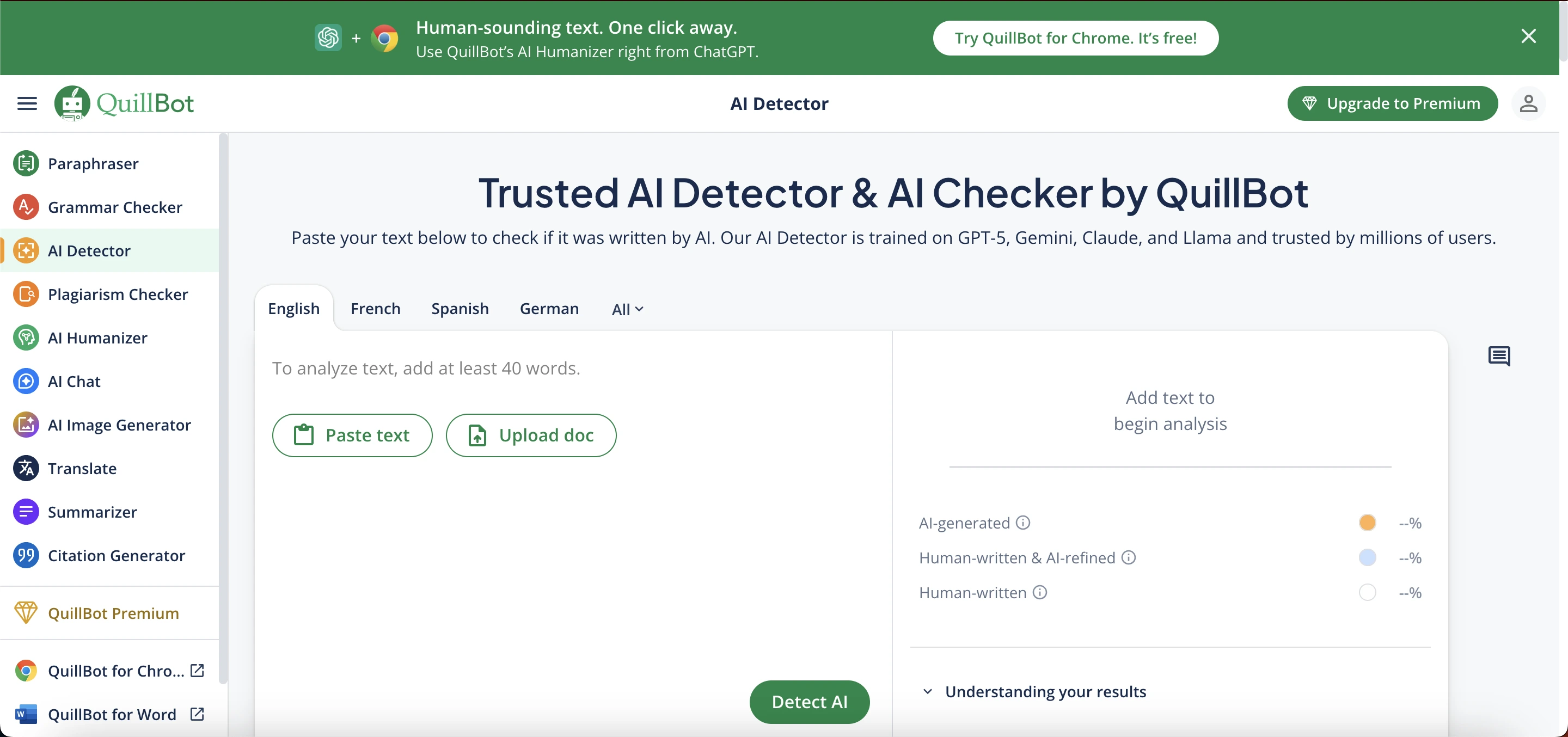 Many users rely on QuillBot for paraphrasing and grammar checks, so its AI detector has gained attention quickly. Still, people want to know: is QuillBot AI detector accurate enough to trust?
Key Features of QuillBot AI Detector
Understanding features helps answer the real question: is QuillBot AI detector accurate for your needs.
1. Simple Text Input
Users can paste any text into the detector and receive results in seconds.
2. Probability Scoring
The tool returns a score showing how likely the text is written by AI. This is a probability, not a final decision.
3. Color-Coded Results
Some versions use color or labels like “Likely AI” or “Likely Human” to make interpretation easier.
4. Supports Multiple Languages
While most accurate in English, it can analyze text in several other languages.
5. Integrated with QuillBot Tools
The detector works with paraphrasing and writing tools, allowing users to compare if paraphrased text still looks AI-written.
6. No Public Database Match
Unlike plagiarism tools, it does not check against published content. This means original text can be analyzed without online comparison.
How It Works
The QuillBot AI Detector uses language pattern analysis to evaluate whether text may be AI-generated. In simple terms, it examines elements such as sentence structure, word repetition, predictability of phrasing, flow consistency, and overall statistical language patterns.
AI-generated content often follows structured and predictable patterns, while human writing typically includes natural variation, emotion, and occasional inconsistencies. The detector attempts to identify these differences to estimate whether the text was likely written by AI or a human.
QuillBot AI Detector Accuracy
In many tests, QuillBot AI Detector picks up AI writing that is clearly generated with no editing. This means for basic, original AI text, it can correctly predict AI involvement.
So when content is from a known AI source and not changed much, the answer to is QuillBot AI detector accurate is closer to “Yes, reasonably often.”
But keep in mind that no detector is perfect or consistent across all types of writing.
Accuracy of the QuillBot AI Detector for Edited
Text that has been edited by humans after being created by AI can easily deceive detectors, including QuillBot. This also applies to intentional human tweaks or paraphrasing.
Similarly, strongly written human text especially formal or well-structured writing can sometimes be labeled as AI-written. This happens because both humans and AI share similar patterns in clear academic or professional writing.
Therefore, when asking is QuillBot AI detector accurate for human text, the honest answer is: sometimes, but not always.
Accuracy Overview
Text Type | Detection Reliability |
|---|---|
Raw AI-generated text | Medium to High |
Edited AI content | Low |
Human-written content | Medium to Low |
Short or unclear text | Low |
Long, structured documents | Slightly higher accuracy |
Read Also: What AI Detector Does Turnitin Use: Complete Guide 2025
Real Use Cases for QuillBot AI Detector
Let’s dive deeper into when you can use this tool wisely.
1. Reviewing AI Drafts
When you use an AI writing tool and want to check how “AI-like” your draft appears, this detector gives a quick indication.
2. Self-Checking Before Publication
Writers may use this to evaluate whether the tone feels too mechanical.
3. Comparing Before & After Edits
You can check how paraphrasing or editing changes AI probability.
4. Academic Honesty Checks
While some educators use it as a reference, it should not be a sole decision tool for academic review.
5. Legal or Contract Decisions
Not reliable for legal proof of authorship or compliance use.
Because of these limits, the answer to is QuillBot AI detector accurate depends on how you apply it.
Common Problems That Affect Accuracy
Knowing limitations makes you smarter about results.
Human patterns resemble AI Formal, structured writing often looks like AI output.
Short text gives weak evidence Short paragraphs lack enough data for reliable scoring.
Edited AI text passes as human Final human touch often removes detectable AI patterns.
These problems help explain why is QuillBot AI detector accurate cannot always be a clear Yes or No.
QuillBot AI Detector vs Other Tools
Feature / Aspect | QuillBot AI Detector | Free Online AI Detectors | Paid AI Detection Tools | Educational Built-in Tools |
|---|---|---|---|---|
Cost | Free | Free | Paid (Subscription-based) | Usually included with institution access |
Detection Method | Pattern and language analysis | Basic pattern matching | Advanced AI models and metadata analysis | Combined AI models and academic writing signals |
Accuracy Level | Moderate | Moderate to Low | High | High to Moderate |
Performance on AI-Generated Text | Detects obvious AI content | Often inconsistent | More reliable results | Generally reliable |
Performance on Human-Written Text | Can give false positives | Higher chance of false positives | Lower false positives | Lower false positives |
Handling Edited or Paraphrased Text | Limited effectiveness | Poor effectiveness | Better handling | Better handling |
Overall Reliability | Competitive among free tools | Varies widely | More consistent | Consistent in academic settings |
Comparison Verdict | On par with free tools | Inconsistent | Superior to free tools | More reliable than free tools |
Tips to Improve Detection Confidence
Since the QuillBot AI Detector is not perfect, following a few best practices can help improve detection confidence.
Using longer text samples of 400 words or more allows the tool to identify language patterns more clearly, which can lead to more reliable results. Avoiding overly formal or template-style writing is also helpful, as such formats often trigger false AI flags.
To get a clearer picture, it’s best to compare results from multiple AI detection tools instead of relying on just one.
Finally, combining detector results with human review remains the most effective approach, as human judgment can better understand context and writing intent. Together, these tips help you make the most of the tool’s capabilities.
Pros and Cons at a Glance
Aspect | Pros | Cons |
|---|---|---|
Ease of Use | Easy to use for quick checks | Not suitable for formal or official evaluation |
Accuracy | Provides a likelihood score for guidance | Can produce false positives and false negatives |
Integration | Integrates well with writing tools | Cannot prove true authorship |
Text Handling | Works on a wide range of text types | Performs poorly with heavily edited or paraphrased text |
Practical Use | Helpful for general awareness and basic screening | Limited reliability for high-stakes decisions |
AI Detection Myths
Many people misunderstand how AI detectors work. A high score does not automatically mean cheating, as formal or well-structured human writing can appear AI-like. Similarly, human-written text is sometimes flagged incorrectly, and no detector, including QuillBot, can identify all AI content perfectly.
Edited AI text or short passages may go undetected, and AI scores do not affect SEO or Google rankings. Understanding these points helps users interpret results more accurately and use the tool as guidance rather than definitive proof.
Conclusion
So, is QuillBot AI detector accurate? It offers moderate accuracy, especially for clearly AI-generated text. However, it can struggle with human-written or edited content and may produce false results.
QuillBot AI Detector works best as a supporting tool, not as final proof of authorship. It can help with quick reviews and awareness, but human judgment is still necessary.
In short, is QuillBot AI detector accurate enough to rely on completely? No. It is useful for guidance, but results should always be reviewed carefully.
Frequently Asked Questions (FAQs)
Is QuillBot AI Detector accurate for academic use?
No. It’s helpful, but not reliable enough to be the only judgment tool in academic situations.
Can it detect all AI writing?
No. Edited AI text often goes undetected.
Is QuillBot AI Detector accurate in languages other than English?
It works in multiple languages, but accuracy is usually highest in English.
Can QuillBot AI Detector replace human review?
No. Human review remains critical.
Does using this tool affect SEO?
No. Google focuses on content quality, not AI detection tool scores.