

Academic research can feel overwhelming. Students and professionals often struggle with long papers, complex language, and limited time. This is where scholar gpt becomes useful. It is designed to support learning and research by helping users understand academic content in a simpler and faster way.
What Is Scholar GPT?
Scholar GPT is an AI-powered research assistant focused on academic and scholarly content. It helps users explore research papers, journals, and academic topics without needing advanced technical knowledge.
Instead of reading dozens of pages, users can ask questions and receive clear, structured answers based on academic sources.
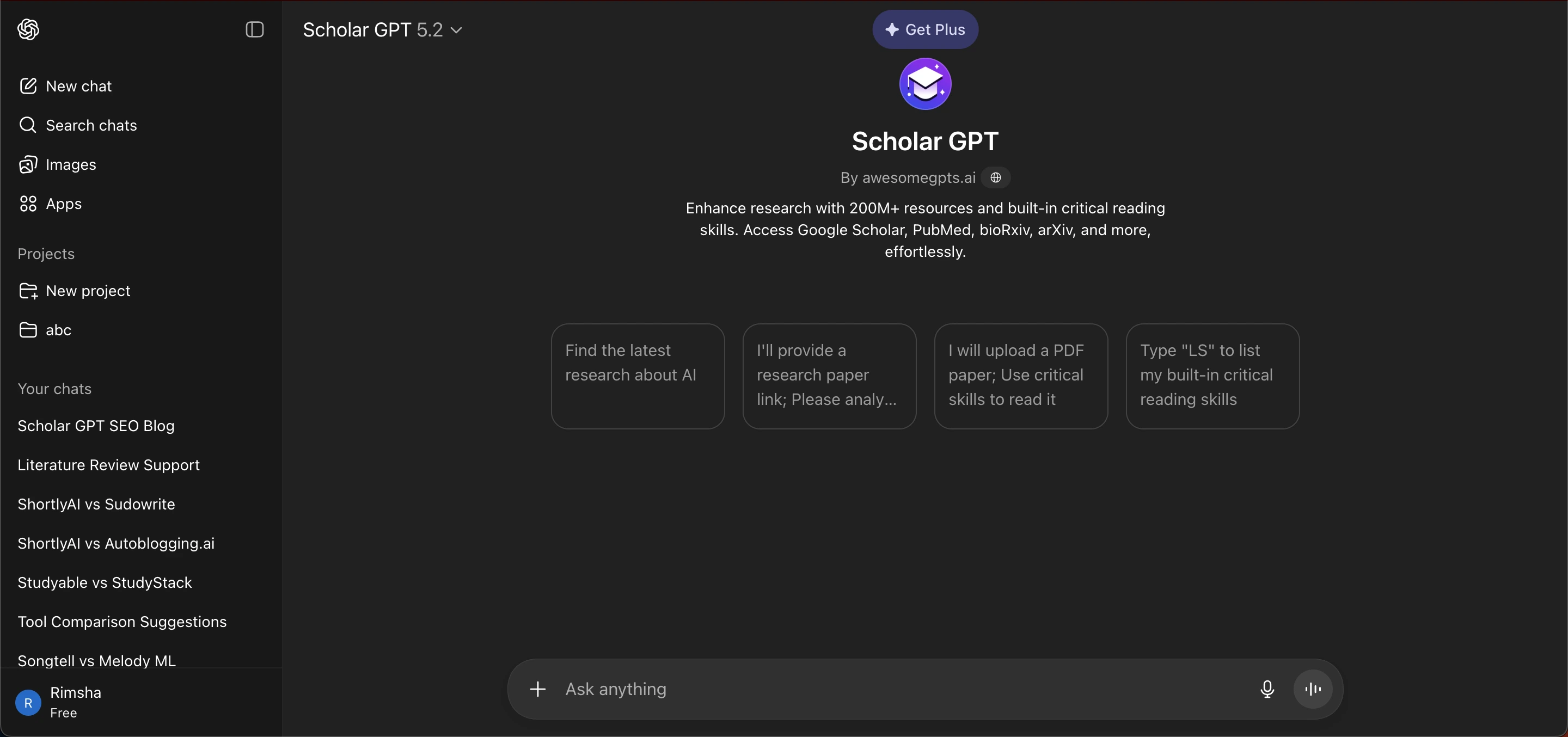 The main goal is to save time while improving understanding. It does not replace original research but supports it by making information easier to access and interpret.
How It Works?
a5eScholar GPT processes academic-style questions and responds with summarized explanations. It analyzes scholarly texts, highlights important points, and presents information in a clear format. Users can interact with it using natural language, making it suitable even for beginners.
While using it, users typically:
Ask a research-related question
Request a summary of a topic or paper
Clarify difficult academic terms
Compare theories or findings
The tool focuses on clarity, relevance, and educational value.
Key Features
It comes with several features that make academic research and study easier. Here’s a detailed look:
1. Academic-Focused Responses
Scholar GPT is specifically designed to handle scholarly topics. It provides responses that reflect academic standards, ensuring that users get accurate and structured explanations rather than general answers.
2. Simplified Summaries of Research Papers
Research papers can be long and difficult to read. Scholar GPT condenses papers into short summaries, highlighting the main arguments, findings, and conclusions. This helps students and researchers save time and grasp essential points quickly.
3. Explanation of Complex Concepts
Many academic topics contain jargon and complex ideas. Scholar GPT can explain difficult terms, theories, and methods in simple language, making it easier for beginners and non-specialists to understand.
4. Research Support and Guidance
Scholar GPT can assist in exploring research topics, outlining papers, and reviewing existing studies. It can help users identify key points in literature, organize ideas logically, and even suggest directions for further study.
5. Interactive Question and Answer
Users can interact with scholar gpt in natural language. They can ask follow-up questions, seek clarification, or dive deeper into specific topics. This makes the research process more dynamic and engaging.
6. Time-Saving Tool
By summarizing content and highlighting important details, scholar gpt significantly reduces the time spent reading and analyzing academic papers. This allows users to focus more on understanding and applying knowledge.
7. Versatile Use Across Disciplines
Scholar GPT is not limited to one subject. It can be applied to various academic fields, including science, humanities, social sciences, and technology, making it a versatile tool for learners and researchers.
Read Also: QuizMate Review: Best AI Study Tool for Students
Use Cases
1. For Students
It helps students understand difficult subjects by breaking complex topics into simpler explanations, summarizes lengthy textbooks or research papers into clear and concise points, supports effective exam preparation through quick revision and practice, and assists in writing assignments and essays with better structure, clarity, and ideas.
2. For Researchers
It supports reviewing existing literature efficiently, helps explore new and emerging research areas, enables comparison of different academic viewpoints, and clarifies research methods to improve understanding and application in scholarly work.
3. For Educators
It helps educators create clear lesson explanations, simplifies complex academic concepts for easier understanding, and supports student learning by making content more engaging, accessible, and effective.
4. For Lifelong Learners
It supports learning new academic topics more easily and enables reading and understanding research materials without being hindered by complex technical language or jargon.
Boosting Academic Performance with Scholar GPT
Scholar GPT can help students improve grades by simplifying complex topics, summarizing research, and clarifying doubts. It can also support time management, allowing students to focus on studying effectively.
Scholar GPT vs Traditional Research Methods
Aspect | Scholar GPT | Traditional Research Methods |
|---|---|---|
Process | Provides quick summaries, explanations, and simplified understanding of academic content | Involves reading multiple papers, taking detailed notes, and manually analyzing findings |
Time Efficiency | Saves time by condensing information and highlighting key points | Time-consuming due to thorough reading and manual synthesis of information |
Ease of Understanding | Simplifies complex concepts, making them easier to grasp | May be challenging, especially with dense academic language or technical jargon |
Depth and Accuracy | Useful for overview and initial understanding, but depth may vary by topic | Provides in-depth, peer-reviewed, and highly accurate information |
Best Use | Supports learning, revision, and preliminary research | Essential for citations, detailed analysis, and comprehensive academic work |
Combined Approach | Works best alongside traditional research to improve efficiency without compromising accuracy | Traditional research en |
Best Practices
Ask clear and specific questions to receive accurate, focused, and relevant explanations instead of overly general responses.
Use it for understanding, not copying, by learning concepts in your own words rather than submitting generated content as original work.
Verify key facts from original sources such as textbooks, journals, or peer-reviewed papers to ensure accuracy and reliability.
Combine it with textbooks and research papers to deepen knowledge and gain proper academic context.
Integration With Other Academic Tools
Scholar GPT can complement tools like reference managers, note-taking apps, and online databases. Using it alongside these tools creates a more efficient workflow for research and learning.
Pros and Cons
Pros | Cons |
|---|---|
Saves time on reading and research by summarizing lengthy academic content | Should not be used as the only research source |
Improves understanding of complex academic material | Information still needs to be verified by users |
Supports structured and organized learning | Does not replace in-depth, peer-reviewed reading |
Helps reduce information overload by highlighting key points | Contextual depth may vary depending on the topic |
Useful for both beginners and advanced users | Requires responsible use to avoid over-reliance |
Especially helpful for users who struggle with academic language | Works best as a support tool, not a substitute for original academic work |
Is Scholar GPT Reliable?
Scholar GPT is designed to assist with learning, not to provide final academic conclusions. Users should always cross-check important information with original sources. When used correctly, scholar gpt can be a reliable learning companion.
Who Should Use Scholar GPT?
It is ideal for:
University and college students
Academic researchers
Teachers and educators
Independent learners
Anyone involved in learning or research can benefit from scholar gpt when used responsibly.
Common Mistakes to Avoid
When using Scholar GPT, it is important to avoid relying solely on AI for research, as it cannot replace thorough, peer-reviewed sources.
Users should not copy AI-generated text directly, but instead use it to understand concepts and rephrase in their own words.
Ignoring the verification of facts is another common mistake, since the information provided may need confirmation from original sources.
Additionally, using Scholar GPT without combining it with other study resources, such as textbooks, research papers, or lecture notes, can limit learning and reduce the depth of understanding.
Following these guidelines ensures responsible and effective use of the tool.
Tips for Getting the Most Out of Scholar GPT
Use specific keywords when asking questions
Break down complex topics into smaller queries
Combine summaries with personal notes
Review the original sources to ensure accuracy
Final Thoughts
Scholar GPT is a helpful academic assistant that supports students and researchers in understanding complex information. It simplifies learning, saves time, and improves clarity. While it should not replace original research, it works well as a supporting tool.
By using scholar gpt wisely, users can enhance their academic journey and gain confidence in handling scholarly content.
Frequently Asked Questions (FAQs)
What is scholar gpt used for?
It is mainly used to help students, researchers, and learners understand academic topics. It assists with summarizing research papers, explaining complex concepts, and supporting study and research tasks.
Is scholar gpt free to use?
Access to scholar gpt may depend on the platform offering it. Some versions may be available for free with limitations, while others may require a subscription or paid access.
Can scholar gpt replace academic research?
No, It cannot replace academic research. It is a support tool that helps users understand content faster, but original papers, books, and verified sources should always be used for final research work.
Is scholar gpt suitable for beginners?
Yes, scholar gpt is suitable for beginners. It explains academic topics in simple language, making it helpful for students who are new to research or complex subjects.
Can scholar gpt help with writing assignments?
Scholar GPT can help by explaining topics, summarizing sources, and helping users organize ideas. However, users should write assignments in their own words and follow academic integrity rules.